Frontend portfolio · Project case study
Rocketify
A crash-game interface with state you can inspect.
From a visual mock to a playable demo: place a stake, follow a round, inspect its outcome, and reload without paying the same result twice.
Simulated credits and opponents. No real funds or payment services.
Built with
- Next.js 15 · React 18
- Chart.js · Tailwind CSS
- Checked JavaScript · TypeScript
- Playwright · GitHub Actions
Client-side simulation · Responsive UI · Per-tab persistence
The interface
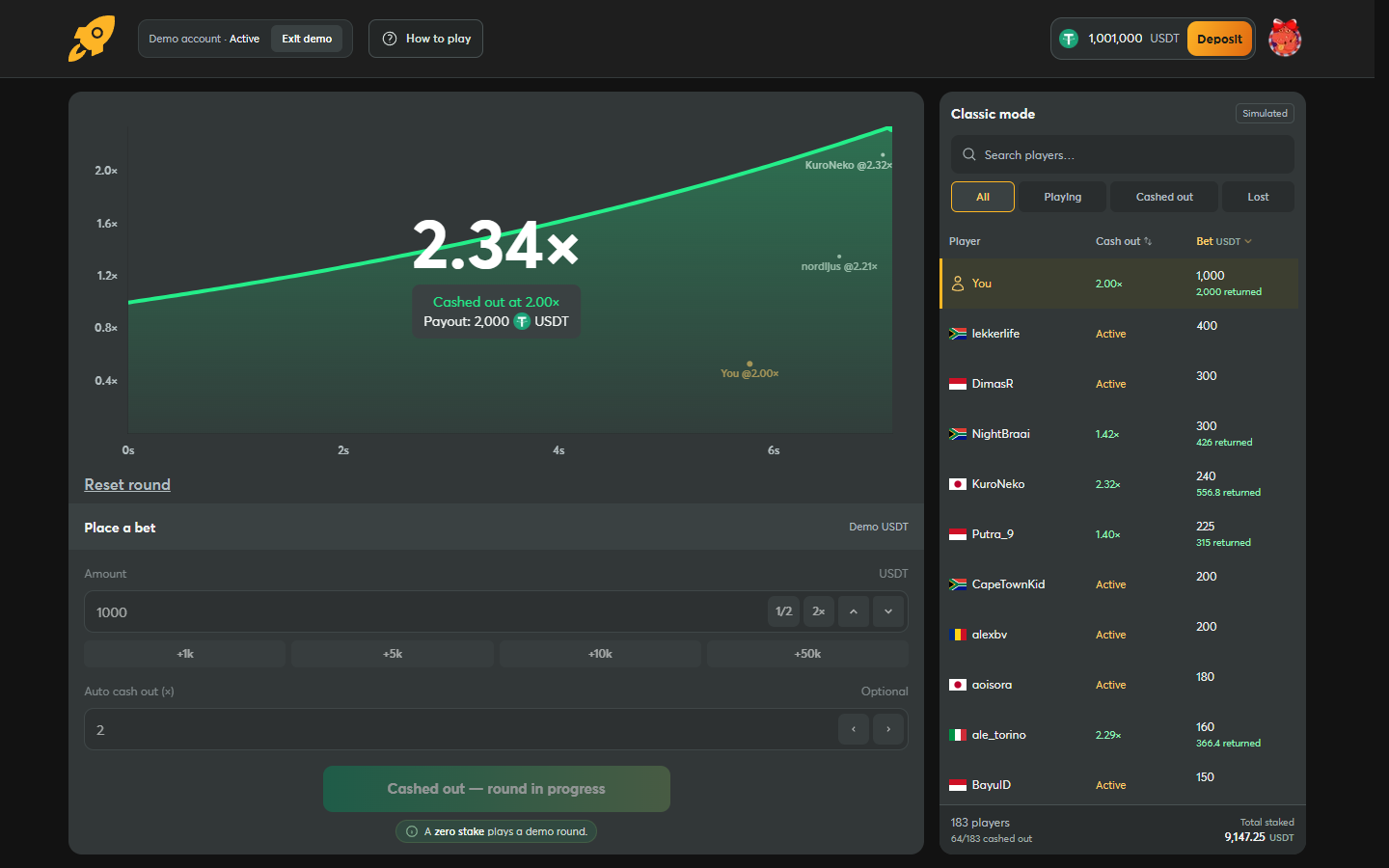
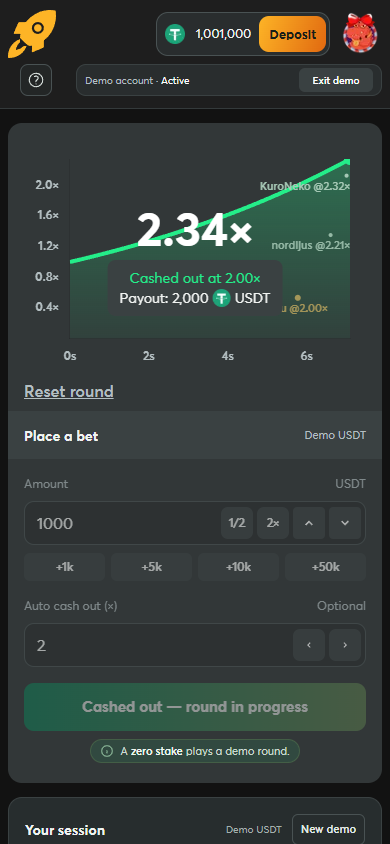
One round, across both layouts.
Actual production-app captures with a fixed clock and seeded mock outcome. The script uses the normal controls. Select an image to inspect the full-size capture in a new tab.
Interaction design
Controls with a clear purpose.
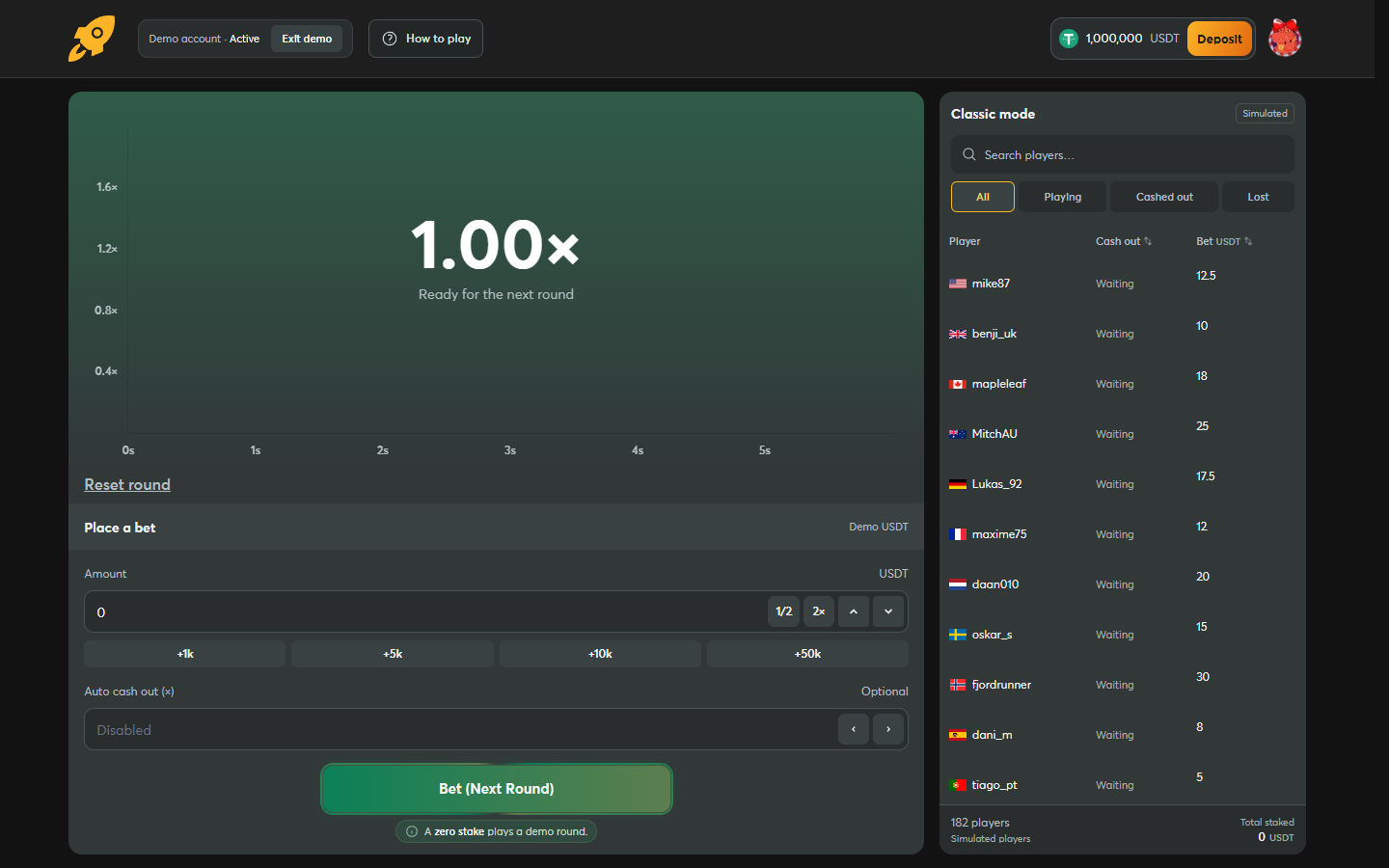
A clear starting point
A fresh demo supplies 1,000,000 credits. Quick-add stakes, an optional auto cash-out target, and a compact practice note make the first action clear. The idle button’s moving border respects reduced-motion preferences.
A player list you can explore
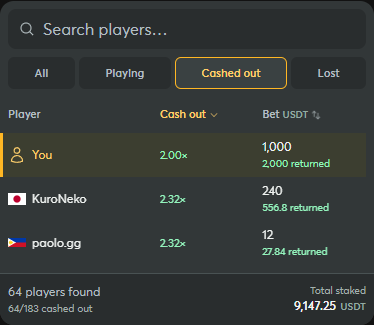
Combine nickname search with round filters, then sort stakes or cash-out multipliers. Your matching row stays pinned, while the total staked continues to describe the entire round.
Try it yourself
A two-minute walkthrough.
Demo access is immediate. No registration is needed to explore.
Place a small stake
Start with 1,000,000 demo USDT. Use +1k to choose a 1,000-unit stake and set 2.00 as the optional auto cash-out target. Cancel during the six-second countdown to see the full refund.
Follow the same round
Cash out manually before the crash, or let the auto target run. Explore the player filters and sortable columns while the list and chart follow the same round. An earlier crash loses the stake.
Inspect the result
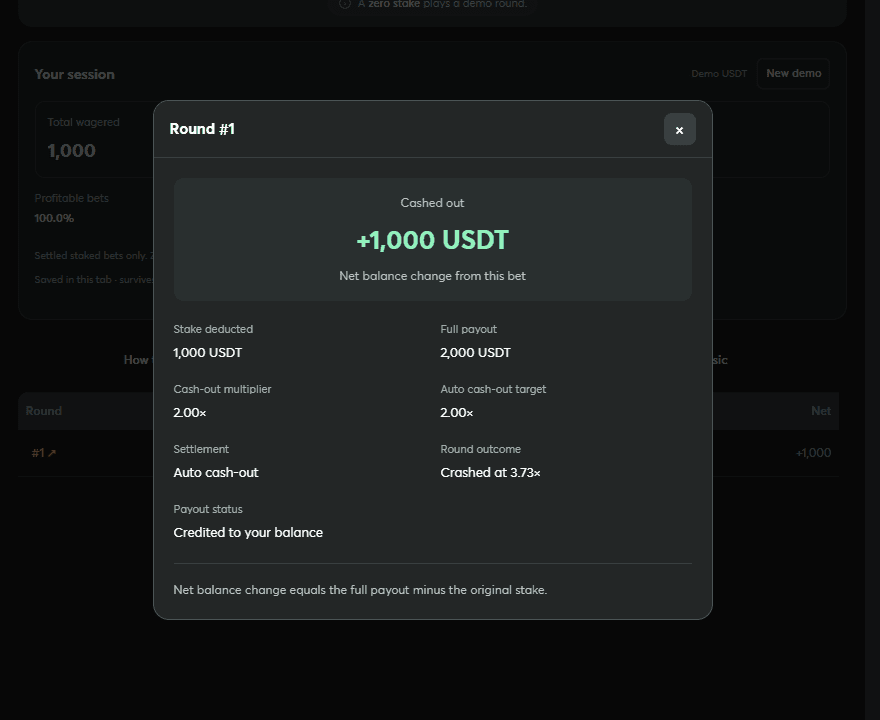
Open History and select a round. A 1,000-unit stake at 2.00 returns 2,000, including the stake: a net gain of 1,000. Compare the result with Your session and the wallet balance.
Reload and explore
Reload to restore this tab, or open the demo in a fresh tab for an independent session. Visit the wallet, search players, and try the narrow-screen layout.
Reset round affects the current round. Start fresh resets this tab’s wallet and results after confirmation.
Engineering decisions
The state behind the interface.
One session owns the money
A shared session applies game and wallet changes together. Bets reserve a stake immediately; each payout is credited once when its one-second arrival completes.
Elapsed time drives the round
The multiplier comes from elapsed time rather than frame counts. Skipped frames still resolve an earlier auto cash-out before a later crash.
Exact values cross the boundary
Amounts are decimal strings in storage and integer micro-USDT during arithmetic. Runtime validation checks input and restored data; strict types check the core code.
Reloads preserve the outcome
Saved deadlines use wall-clock time, then return to the new page’s performance clock. A returning tab advances the existing round and cannot reclaim a lost stake.
One roster, several views
Search, round filters, and numeric sorting share the same player model. The matching user row stays pinned; the exact total staked covers the entire round even when rows are filtered out.
Space follows the screen
Desktop gives 70% of the game area to the chart and 30% to the players. Both panels fill the space below the navbar. Smaller screens stack the controls and provide a compact player panel.
Verification
Evidence you can review.
- First-load JavaScript
- 197 kB
Current game-route estimate, about 86% below the original 1.43 MB build with the whole-country flags bundle.
- Accounting and state
- 67 unit tests
Six-decimal accounting, settlements, stale timers, snapshots, wallet conservation, and player-view rules.
- Browser scenarios
- 104 scenarios
Desktop and mobile checks cover betting, reloads, player tools, local chat, dialogs, layout, and accessibility on the production build.
Verified locally on 20 November 2026. The JavaScript figures are local Next.js production-build estimates, not total page weight or a field-performance score. Automated accessibility scans supplement keyboard checks; they do not establish full WCAG conformance.
Project boundaries
A frontend demonstration.
Players, deposits, and withdrawals are simulated. The bounded mock crash generator is designed for this demo. Demo login saves a local display name and does not create or verify a real account. Backend identity, multiplayer, payments, and repeated automatic betting are outside the current implementation.